FSTAR fact sheets.
Short fact sheets from the International Association of Fire Chiefs' Firefighter Safety Through Advanced Research (FSTAR) initiative, which turned research into resources fire departments can use.
About FSTAR
The IAFC launched FSTAR to close the gap between research and day-to-day fire service practice, with the goal of helping departments make evidence-based decisions that improve safety on the fireground.
Research translation
FSTAR turned more than 25 studies into concise fact sheets on fire dynamics, cardiac health, wellness programs and fire prevention.
Health & safety
It focused on cardiovascular events, respiratory illness, cancer, musculoskeletal injuries and behavioral health, including a medical practitioner's guide to NFPA 1582 physicals.
Outreach
FSTAR held town hall events with the National Institute of Standards and Technology (NIST) on fire dynamics and tactical decision-making.
Heart health
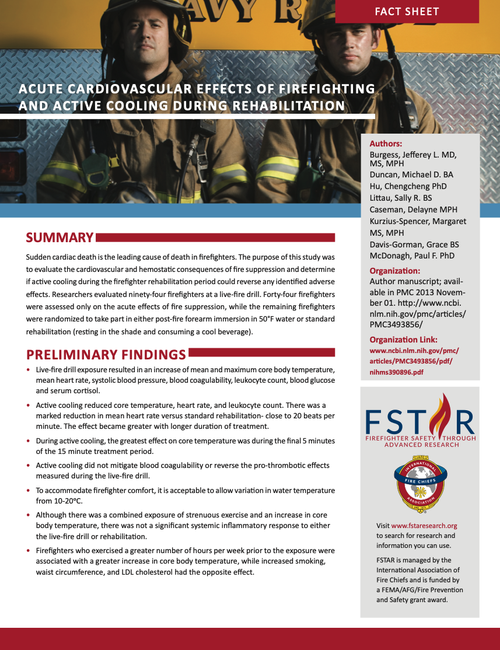
Acute cardiovascular effects
Sudden cardiac death is the leading cause of on-duty death in firefighters. This study looked at the cardiovascular and blood-clotting effects of fire suppression, and whether active cooling during rehab could reverse them. Researchers evaluated 94 firefighters at a live-fire drill. Some were assessed only on the acute effects of fire suppression; the rest were randomized to forearm immersion in 50°F water or standard rehab (resting in the shade with a cool drink).
Fitness
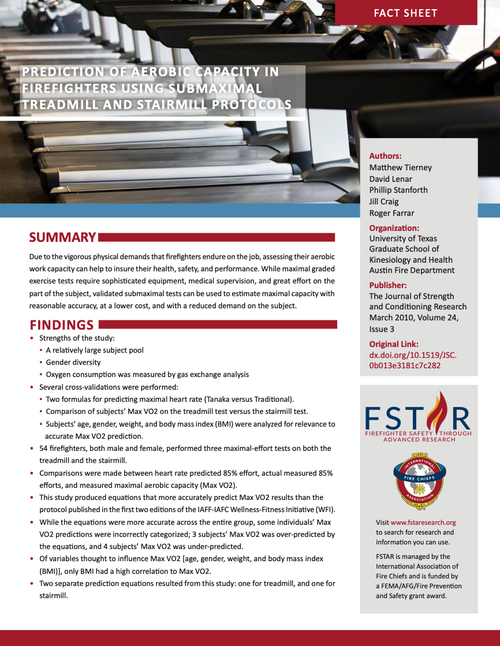
Aerobic capacity
The job is physically demanding, so knowing a firefighter's aerobic work capacity helps protect health, safety and performance. Maximal exercise tests need specialized equipment, medical supervision and an all-out effort. Validated submaximal tests can estimate maximal capacity with reasonable accuracy, at lower cost and with less demand on the person being tested.
Fireground
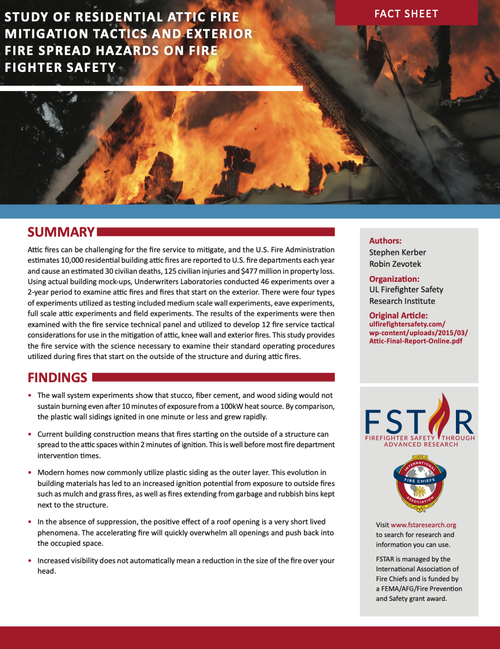
Attic fire mitigation tactics
Attic fires are hard to fight. The U.S. Fire Administration estimates about 10,000 residential attic fires a year, causing about 30 civilian deaths, 125 civilian injuries and $477 million in property loss. Using full building mock-ups, Underwriters Laboratories ran 46 experiments over two years on attic fires and fires that start on the exterior, from wall and eave tests to full-scale attic and field experiments.
Heart health & cancer
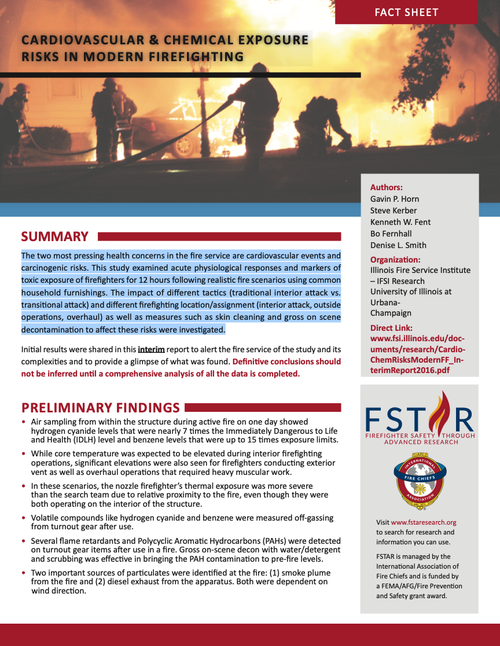
Cardiovascular and chemical exposure
Cardiovascular events and cancer risk are two of the most pressing health concerns in the fire service. This study tracked firefighters' physical responses and markers of toxic exposure for 12 hours after realistic fires using common household furnishings. It compared tactics (interior vs. transitional attack), assignments (interior, outside, overhaul) and measures like skin cleaning and on-scene gross decon.