
PFAS in
Your Blood.
New study identifies key predictors of PFAS levels in U.S. career firefighters
Fire Firefighter Cancer Study (FFCCS) tests 2,056 firefighters to determine what raises and lowers exposure
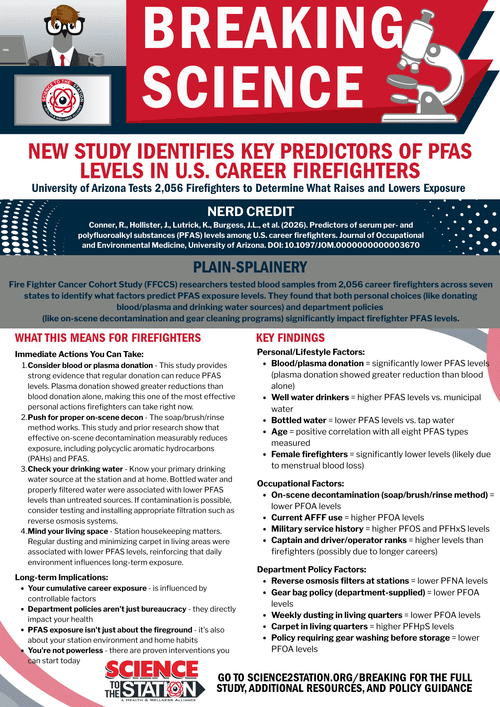 The one-pager for the station >
About this study
- Who did it
- University of Arizona researchers (lead author: Reagan Conner, MPH; principal investigator: Dr. Jefferey Burgess)
- What they did
- Tested blood samples from 2,056 career firefighters in 7 states (Arizona, California, Idaho, Massachusetts, Oregon, Virginia, Washington) between July 2023 and October 2024
- What they found
- Both your personal choices AND your department's policies directly affect how much PFAS is in your blood
- Published
- January 19, 2026, Journal of Occupational and Environmental Medicine
- Full citation
- Conner, R., Hollister, J., Lutrick, K., Burgess, J.L., et al. (2026). Predictors of serum per- and polyfluoroalkyl substances (PFAS) levels among U.S. career firefighters. Journal of Occupational and Environmental Medicine, University of Arizona. DOI: 10.1097/JOM.0000000000003670
Why this matters
What is PFAS?
"Forever chemicals" used in firefighting foam, gear, and thousands of products. They don't break down and they build up in your body.
The health risks
- PFOA = causes cancer (Group 1 carcinogen)
- PFOS = probably causes cancer (Group 2B carcinogen)
- Both linked to heart disease, thyroid problems, and immune issues
- Stays in your body for 3-5 years (half-life)
The firefighter problem
- 100% of firefighters tested had PFAS in their blood
- Firefighters have higher levels than regular people
- Comes from foam, burning materials, contaminated dust, and water
The good news
This study found specific things you can do - and your department can do - to lower your levels
What the study found
Things that lowered PFAS levels
- Donating plasma (17-40% lower)
- Donating blood (6-15% lower)
- Drinking bottled water (8-11% lower)
- Using reverse osmosis water filters
- Washing gear after fires with soap/brush/rinse (9-11% lower)
- Department gear bag policy
- Department policy requiring gear washing before storage
- Weekly dusting in stations
- Weekly hood cleaning programs
Things that raised PFAS levels
- Drinking well water (19-24% higher)
- Using AFFF foam (11% higher PFOA)
- Military service history (8-21% higher)
- Carpet in station living areas
- More years on the job
- Being older (true for everyone, not just firefighters)
Part 1
For firefighters
What you can do right now
1. Donate plasma or blood
What the study showed: Plasma donation had the biggest effect - up to 40% lower PFAS. Blood donation also worked - 6-15% lower.
Why it works: PFAS sticks to proteins in your blood. When you donate, the PFAS leaves your body with the blood or plasma.
How to do it:
- Whole blood: Every 56 days (8 weeks)
- Plasma: Up to twice a week at paid donation centers
- Find a place: redcrossblood.org or search "plasma donation near me"
Bottom line: This showed the strongest results in the study. An Australian study already tested this and proved it works. A U.S. trial is happening now to find the best donation schedule.
2. Check your drinking water
What the study showed:
- Well water drinkers: 19-24% higher PFAS
- Bottled water drinkers: 8-11% lower PFAS
- Reverse osmosis filters: Lower PFAS
At home
- Figure out where your water comes from (well, city, or bottled)
- If you have well water, get it tested for PFAS
- Call your state health department or hire a private lab
- EPA water info: epa.gov/ground-water-and-drinking-water
- If it's contaminated, install a reverse osmosis filter OR switch to bottled water
At your fire station
- Ask your chief to test the station water
- Push for reverse osmosis filters or bottled water at all stations
- Even cheap pitcher filters (like Brita) showed some benefit
Why well water is worse: 13% of Americans use well water. It's not regulated like city water, and most people don't test it. If it's contaminated, you don't know unless you check.
3. Wash your gear after every fire
What the study showed: Firefighters who did soap/brush/rinse decon had 9-11% lower PFOA.
The right way to do it
- Take off your SCBA and gloves
- Wet down your turnout gear
- Apply soap and scrub with a stiff brush
- Rinse everything thoroughly
- Wipe your exposed skin (face, neck, hands) with wipes
Why it works: When smoke cools down, it settles as dust and crud on your gear. That stuff soaks into your body through your skin. Washing it off at the scene stops that from happening.
What your department needs
- Soap, brushes, water, and skin wipes on every apparatus
- A standard procedure that everyone follows
- Training on the right technique
Bonus: This also reduces PAHs (another cancer-causing chemical from fires).
Other things that help
- Use a gear bag - Departments that gave everyone a bag had firefighters with lower PFAS
- Don't bring dirty gear home - Keep contamination at the station
- Push for weekly dusting - Stations that dusted weekly had lower PFAS
- Support hood swap programs - Weekly hood cleaning = lower PFAS
Common questions
"I've been on the job for 20+ years. Is it too late?"
No. Research suggests that actions taken now may still be meaningful, regardless of how long someone has been exposed. Some studies indicate that plasma donation may help reduce PFAS levels in the blood, though results can vary and are not guaranteed.
"What's the single most important thing I can do?"
Donate plasma. It showed the biggest reduction - up to 40% lower for some PFAS types.
"How often should I donate blood?"
Whole blood: every 56 days. Plasma: up to twice a week. A research trial is happening now to figure out the best schedule for PFAS reduction.
"Do Brita-style filters work?"
They help a little. The study found lower PFAS with "other" water sources including pitcher filters. But reverse osmosis works better.
"Does my turnout gear have PFAS in it?"
Probably yes. Research has found fluorine in gear materials. But we don't know yet if that's a major source compared to smoke, foam, and water.
"Should we stop using two sets of gear?"
Don't change anything yet. The study found higher PFAS with a second set, but researchers don't understand why. It might be because people with two sets have longer careers or other factors. Wait for more research.
"What about my family?"
If you have well water at home, get it tested - your whole family drinks it. Never bring contaminated gear into your house or car. Always use a gear bag.
"Is AFFF banned now?"
Not everywhere. The study found current AFFF use = 11% higher PFOA. Push your department to switch to fluorine-free foam.
"We already follow NFPA 1851. Isn't that enough?"
The study found that just meeting NFPA minimum standards wasn't linked to lower PFAS. You need specific policies like requiring gear washing BEFORE storage, not just twice a year advanced cleaning.
"What about food in paper containers?"
Weirdly, people who ate more pizza and fast food had LOWER PFAS in this study. Researchers can't explain it. Don't change your diet based on this finding.
Part 2
For department leadership
Policy & implementation guide. This study proves that your policies directly impact your firefighters' cancer risk. Here's how to use these findings.
Step 1: Assess your current situation
Water
- Where does drinking water come from at each station? (City/municipal, well, bottled)
- When was it last tested for PFAS?
- Do you have any filtration systems?
Gear policies
- Do you require gear to be washed before storing it?
- Does everyone have a department-issued gear bag?
- Do you have a hood swap or weekly hood cleaning program?
- How many sets of gear does each firefighter have?
Decontamination
- Is on-scene decon a formal requirement or just a suggestion?
- Does every apparatus have soap, brushes, water, and wipes?
- Are people trained on the soap/brush/rinse method?
- Do you have SOPs written for on-scene decon?
Station environment
- How often are living quarters dusted?
- Is there carpet in living areas (sleeping, eating)?
- Do you clean apparatus interiors after fires?
- Do gear storage rooms have automatic closing doors?
Step 2: Priority actions
Start here. Based on the study, these four things had the clearest impact:
Priority #1: Water
The finding: Reverse osmosis filters and bottled water = significantly lower PFAS
What to do
- Test water at ALL stations (even city water can be contaminated)
- Get test results and compare to EPA advisory levels
- Choose your solution:
- Option A: Install reverse osmosis systems (better long-term, higher upfront cost)
- Option B: Provide bottled water (cheaper short-term, ongoing cost)
- Option C: Combination (RO for cooking/drinking, bottled as backup)
Budget
- RO systems: $1,500-$5,000 per station (installation) + $200-$500/year (filters)
- Bottled water: ~$50-$150/month per station
- Testing: $300-$600 per water source
Timeline
- Testing: 2-4 weeks
- RO installation: 1-3 months
- Bottled water: Immediate
Priority #2: Gear management policies
The findings:
- Policy requiring gear washing before storage = lower PFOA
- Department-issued gear bags = lower PFOA
- Hood swap/weekly cleaning = lower PFOA
A. Write or update your gear washing policy
- Require all gear to be washed after fire responses before being stored
- Specify WHERE it gets washed (station extractor, sent out, etc.)
- Specify WHEN (within 24 hours, before next shift, etc.)
- Make it enforceable with accountability
Sample policy language:
"All structural firefighting protective equipment exposed to fire products of combustion shall be cleaned using an approved extractor and appropriate detergent within 24 hours of exposure and prior to being returned to storage."
B. Gear bag program
- If you don't supply gear bags, budget for them
- Require use for transporting contaminated gear
- Make it clear: contaminated gear does NOT go in personal vehicles or homes
Budget: $75-$150 per gear bag × number of personnel
C. Hood swap/cleaning program
- Buy extra hoods (2-3 per firefighter)
- Set up a weekly rotation/cleaning schedule
- Assign someone to manage it
- Track compliance
Budget: $50-$100 per hood × number needed
Priority #3: On-scene decontamination
The finding: Soap/brush/rinse method = 9-11% lower PFOA
A. Write or update your on-scene decon SOP
- Make it mandatory after every working fire
- Specify the soap/brush/rinse method (study shows this works best)
- Include skin decon (face, neck, hands)
- Specify who's responsible for ensuring it happens
Sample SOP excerpt:
"Following fire suppression and prior to returning to quarters, all personnel who operated in the hazard zone shall perform on-scene decontamination using the following procedure: [steps 1-5]. Company officers are responsible for ensuring compliance."
B. Stock every apparatus
- Appropriate cleaning solution (safe for turnout gear)
- Stiff brushes
- Water source or adequate water supply
- Personal hygiene wipes
- Bags for contaminated gear if needed
Budget: $100-$200 per apparatus (initial stock) + ongoing supplies
C. Train everyone
- How to do it right
- Why it matters (cancer prevention, not just cleanliness)
- When to do it (every fire, not just "big ones")
Priority #4: Station housekeeping
The findings:
- Weekly dusting = lower PFOA
- Carpet in living quarters = higher PFHpS
- Apparatus interior cleaning = lower PFHpS
A. Update cleaning procedures
- Require dusting of living quarters at least once per week (not monthly)
- Specify what gets dusted (surfaces, blinds, vents, electronics)
- Add apparatus interior cleaning to post-fire procedures
B. Evaluate carpet
- Identify which stations have carpet in living areas
- Prioritize removal in sleeping and eating areas
- Budget for replacement flooring (sealed concrete, VCT, etc.)
Budget: Varies widely - $2-$10 per square foot for flooring replacement
C. Update station cleaning checklists
- Add specific tasks and frequencies
- Assign responsibility
- Track completion
Step 3: Secondary actions
Good to have. These showed some benefit or are worth considering:
Gear storage:
- Automatic closing doors for gear rooms (showed lower PFOA)
- Separate ventilation for gear storage areas
Apparatus interior decon:
- Formal policy for cleaning cabs after fires
- Supplies and procedures for doing it
Contamination zones:
- Mark red/yellow/green zones (though study showed mixed results on this)
Step 4: What didn't work
Don't waste money here. The study found NO significant effect from:
- Just meeting NFPA 1851 minimum standards (you need to do MORE than the minimum)
- Where extractors are located (centralized vs. at each station)
- How gear is dried (turnout dryer vs. air dry)
- HEPA filters in stations
- Having decon kits on apparatus (if people don't USE them)
Weird finding: Having a second set of gear was linked to HIGHER PFAS. Researchers don't know why yet. Don't change your gear policies based on this until more research explains it.
Step 5: Build your budget justification
The case for leadership/city council
- This is peer-reviewed science from a major university
- 2,056 firefighters across 7 states prove these interventions work
- PFAS causes cancer - officially classified by international health agencies
- Every firefighter tested had PFAS in their blood
- These policies will reduce cancer risk and future costs
Sample budget memo language
"A January 2026 peer-reviewed study of 2,056 firefighters published in the Journal of Occupational and Environmental Medicine identified specific department policies associated with significantly lower PFAS levels. PFAS are 'forever chemicals' classified as carcinogens that were detected in 100% of firefighters tested. The study found that [specific policy] was associated with [X%] lower PFAS levels. Implementation cost is estimated at $[amount], which will reduce long-term cancer risk, workers' compensation costs, and recruiting/retention challenges."
Costs vs. benefits
- Upfront costs: RO systems, gear bags, extra hoods, flooring = $[your estimate]
- Ongoing costs: Water, cleaning supplies, maintenance = $[your estimate]/year
- Savings: Reduced cancer cases, lower workers' comp, fewer disability retirements, better retention
- Intangible benefits: Healthier firefighters, improved morale, competitive advantage in hiring
Step 6: Communicate with your people
Tell your firefighters:
- What PFAS is and why it matters
- What the study found
- What the department is going to do about it
- What they can do personally (donate plasma, check home water, etc.)
- Timeline for changes
Ways to communicate:
- Shift briefings
- Department-wide email/memo
- Post this website link in stations
- Include in safety training
- Discuss at union meetings
Be transparent:
- If budget is tight, say so and explain the timeline
- If testing found contaminated water, share results
- If you're making changes, explain why
- Ask for input on implementation
Step 7: Track and measure
Process measures (Are people doing it?):
- Gear washing logs
- Decon compliance observations
- Hood rotation tracking
- Cleaning checklists completed
Outcome measures (Is it making a difference?):
- Encourage firefighters to join the ongoing research study
- Some occupational health programs offer PFAS testing
- Track cancer diagnoses (though this takes years to show change)
Annual review:
- Are policies being followed?
- Do procedures need updating?
- What's working and what's not?
- What does new research say?
Step 8: Stay informed
This research is ongoing:
- The Fire Fighter Cancer Cohort Study is a 30-year project
- More findings will come out about what works
- New interventions will be tested
- Technology and products will improve
How to stay updated:
- Check science2station.org/breaking for new studies
- Follow University of Arizona firefighter research
- Attend fire service conferences with research tracks
- Subscribe to occupational health publications
- Connect with other departments implementing these changes