
Gear That
Fits.
New study identifies new PPC production imperatives: improvements reflect vast variety of physiques that exist among current fire service professionals
Considering the female form to improve garment fit and function
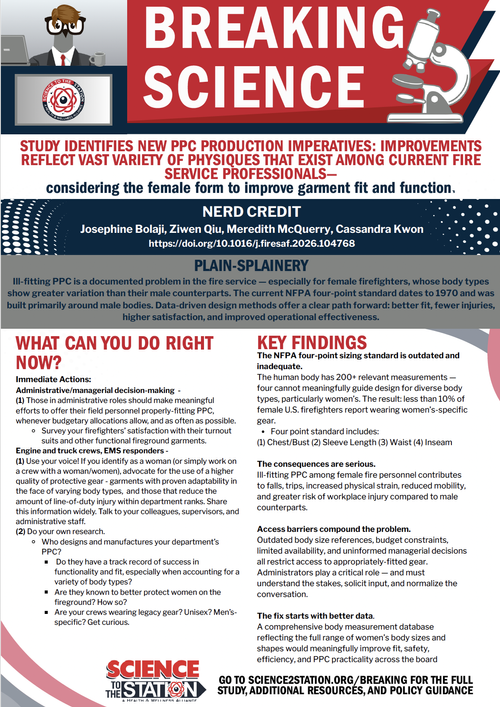 The one-pager for the station >
About this study
- Who did it
- Josephine Bolaji, Ziwen Qiu, Meredith McQuerry, and Cassandra Kwon
- The short version
- Ill-fitting PPC is a documented problem in the fire service, especially for female firefighters, whose body types show greater variation than their male counterparts. The current NFPA four-point standard dates to 1970 and was built primarily around male bodies. Data-driven design methods offer a clear path forward: better fit, fewer injuries, higher satisfaction, and improved operational effectiveness.
- Published
- Fire Safety Journal, vol. 163, article 104768 (September 2026 issue)
- Full citation
- Bolaji, J., Qiu, Z., McQuerry, M., & Kwon, C. (2026). The suitability of personal protective clothing sizing standards for U.S. structural female firefighters. Fire Safety Journal, 163, 104768. DOI: 10.1016/j.firesaf.2026.104768
Key findings
The NFPA four-point sizing standard is outdated and inadequate
The human body has 200+ relevant measurements. Four cannot meaningfully guide design for diverse body types, particularly women's. The result: less than 10% of female U.S. firefighters report wearing women's-specific gear.
The four-point standard includes: (1) Chest/Bust (2) Sleeve Length (3) Waist (4) Inseam
The consequences are serious
Ill-fitting PPC among female fire personnel contributes to falls, trips, increased physical strain, reduced mobility, and greater risk of workplace injury compared to male counterparts.
Access barriers compound the problem
Outdated body size references, budget constraints, limited availability, and uninformed managerial decisions all restrict access to appropriately-fitted gear. Administrators play a critical role. They must understand the stakes, solicit input, and normalize the conversation.
The fix starts with better data
A comprehensive body measurement database reflecting the full range of women's body sizes and shapes would meaningfully improve fit, safety, efficiency, and PPC practicality across the board.
Part 1
For firefighters
Engine and truck crews, EMS responders.
What you can do right now
1. Use your voice
If you identify as a woman (or simply work on a crew with a woman/women), advocate for the use of a higher quality of protective gear: garments with proven adaptability in the face of varying body types, and those that reduce the amount of line-of-duty injury within department ranks. Share this information widely. Talk to your colleagues, supervisors, and administrative staff.
2. Do your own research
Who designs and manufactures your department's PPC?
- Do they have a track record of success in functionality and fit, especially when accounting for a variety of body types?
- Are they known to better protect women on the fireground? How so?
- Are your crews wearing legacy gear? Unisex? Men's-specific? Get curious.
Part 2
For department leadership
Administrative and managerial decision-making.
Fit the gear to your people
- Those in administrative roles should make meaningful efforts to offer their field personnel properly-fitting PPC, whenever budgetary allocations allow, and as often as possible.
- Survey your firefighters' satisfaction with their turnout suits and other functional fireground garments.
More coming
More tools and resources for this Breaking Science are on the way.