
PTSD, Sleep
& Nightmares.
New study: 4-day therapy retreat dramatically improves PTSD, insomnia, and nightmares in firefighters
First-ever randomized study of culturally adapted mental health treatment shows major results
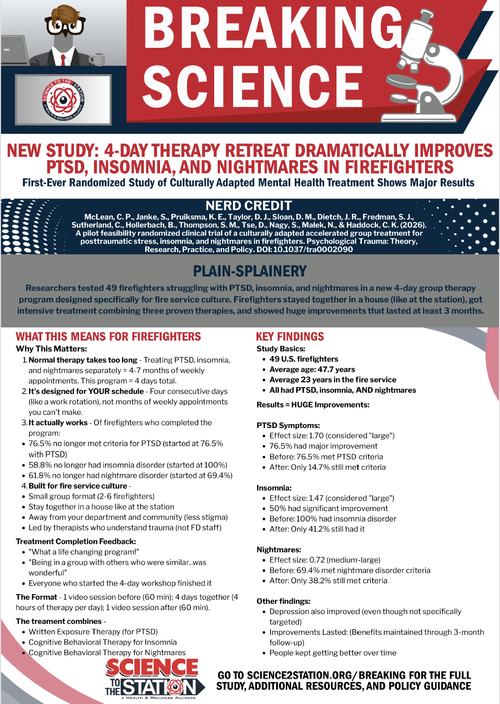 The one-pager for the station >
About this study
- Who did it
- Dr. Carmen McLean and research team from the National Center for PTSD, University of Arizona, and partner institutions
- What they did
- Tested 49 firefighters struggling with PTSD, insomnia, and nightmares in a new 4-day group therapy program designed specifically for fire service culture
- What they found
- Firefighters who completed the program showed huge improvements. From before treatment to 1 month after, the share meeting PTSD criteria dropped from 76.5% to 14.7%, insomnia disorder from 100% to 41.2%, and nightmare disorder from 69.4% to 38.2%. Benefits lasted at least 3 months.
- Published
- January 19, 2026, Psychological Trauma: Theory, Research, Practice, and Policy
- Full citation
- McLean, C. P., Janke, S., Pruiksma, K. E., Taylor, D. J., Sloan, D. M., Dietch, J. R., Fredman, S. J., Sutherland, C., Hollerbach, B., Thompson, S. M., Tse, D., Nagy, S., Malek, N., & Haddock, C. K. (2026). A pilot feasibility randomized clinical trial of a culturally adapted accelerated group treatment for posttraumatic stress, insomnia, and nightmares in firefighters. Psychological Trauma: Theory, Research, Practice, and Policy. DOI: 10.1037/tra0002090
Why this matters
The firefighter mental health problem
Firefighters face high rates of PTSD (8-37%), insomnia (47-53%), and nightmares (19%) compared to the general population. These problems usually occur together and make each other worse. Beyond the suffering they cause, they lead to poor job performance, safety risks, disability claims, and suicide risk.
The treatment barrier
Treating PTSD, insomnia, and nightmares separately requires 4-7 months of weekly appointments. Firefighter shift schedules make this nearly impossible. Mental health stigma in the fire service keeps many from seeking help, and most firefighters won't use services provided by their own departments.
What this study tested
A completely different approach - compress all treatment into 4 consecutive days, deliver it in small groups (2-6 firefighters), recreate fire station culture by staying together in a house, and provide it away from participants' departments and communities. This is the first controlled study of a culturally adapted mental health treatment specifically designed for firefighters.
What the study found
The results: PTSD
- Effect size: 1.70 (considered "large" - huge improvement)
- 76.5% had major improvement (10+ point drop on standardized test)
- Before treatment: 76.5% met full PTSD diagnostic criteria
- 1 month after treatment: Only 14.7% still met criteria
- Average PTSD score dropped from 40.0 to 22.3 (out of 80)
The results: Insomnia
- Effect size: 1.47 (considered "large")
- 50% had significant improvement (6+ point drop)
- Before treatment: 100% had insomnia disorder
- 1 month after treatment: Only 41.2% still had it
- Average insomnia score dropped from 18.5 to 12.4 (out of 28)
The results: Nightmares
- Effect size: 0.72 (medium-large)
- Before treatment: 69.4% met nightmare disorder criteria
- 1 month after treatment: Only 38.2% still met criteria
- Average nightmare score dropped from 7.5 to 3.9 (out of 28)
Other findings
- Depression also improved significantly (even though not specifically targeted)
- 100% of firefighters who started the 4-day workshop completed it
- All dropout happened before the workshop (due to travel/scheduling barriers)
- Improvements maintained through 3-month follow-up
- Participants continued getting better over time
- High satisfaction ratings and willingness to recommend to others
Part 1
For firefighters
What you can do right now
Know the warning signs
Participants in this study averaged 23 years in the fire service before getting help. Don't wait years.
Signs you might benefit:
- Intrusive memories or flashbacks of traumatic calls
- Avoiding things that remind you of traumatic events
- Trouble falling asleep or staying asleep
- Frequent nightmares about work or trauma
- Feeling on edge, irritable, or hypervigilant
- Depression or pulling away from family and friends
Talk to your department
Travel costs and scheduling were the biggest barriers to enrollment in this study. Advocate for:
- Mental health benefits that cover intensive treatment
- Time off policies that support 4-day treatment programs
- Department culture where getting help is normalized
- Share this research with leadership
Is this available now?
This was a research study, so it's not available as a clinical service yet. Researchers are working on making it available, which requires training more therapists, identifying locations, and working with insurance companies.
Contact for updates: Dr. Carmen McLean, National Center for PTSD, carmen.mclean4@va.gov
What you can do while waiting
- Seek evidence-based PTSD treatment (Prolonged Exposure, Cognitive Processing Therapy, Written Exposure Therapy)
- Ask providers about CBT for Insomnia and CBT for Nightmares
- Consider intensive outpatient programs if available in your area
- Use confidential resources: Fire/EMS Helpline 1-888-731-FIRE (3473)
Common questions
"How is this different from regular therapy?"
Regular therapy: PTSD (8-15 weeks) + insomnia (4-8 weeks) + nightmares (4-6 weeks) = 16-29 weeks total if done separately. This program: 4 days total. Same evidence-based treatments, same effectiveness, compressed timeline. Why accelerated works: No time between sessions to avoid, full focus without distractions, builds momentum, less dropout. Research shows accelerated PTSD treatment works as well as weekly treatment.
"Why group therapy instead of individual?"
Research shows group PTSD therapy works just as well as individual therapy. For firefighters, group may be better because: you're used to working in teams, reduces isolation ("I'm not the only one"), peer support from people who understand the job, matches fire service culture. What participants said: "Being in a group with others who were similar, who had gone through similar things, was wonderful. It was a comfortable space."
"Will people from my department be in my group?"
No. The study specifically avoided putting firefighters from the same department together to protect privacy and allow people to speak freely without department politics.
"What if my trauma happened at work?"
79.6% of traumas in this study were job-related: transportation accidents (35%), sudden violent death (24%), sudden accidental death (22%), physical assault, fires, other on-duty incidents. The treatment is designed for occupational trauma.
"I have sleep apnea too. Will this still work?"
39-46% of participants had possible sleep apnea. The treatment still worked. You may need additional treatment for sleep apnea (like CPAP), but this program can still help with insomnia and nightmares. Other sleep problems participants had: shift work sleep disorders (19-35%), restless legs syndrome (4-12%), sleepwalking, REM sleep behavior disorder. Treatment worked despite these complications.
"Do I have to talk about my trauma in front of everyone?"
No. You write about your trauma privately (30 minutes, five times over the 4 days). You're in the same room as others who are also writing, but what you write is private - you don't share it with the group. The therapist gives you individual feedback. Instructions and brief check-in happen as a group, but detailed trauma content stays between you and the therapist.
"What if my trauma is really severe?"
The study included firefighters with moderate to severe PTSD (average scores 30-40 out of 80). 76.5% met full diagnostic criteria for PTSD. Average 23 years in the fire service with years of accumulated trauma. The treatment worked for them. You're not "too bad" for this treatment.
Part 2
For department leadership
Policy & implementation guide. This is the first controlled study proving culturally adapted mental health treatment works for firefighters. Here's what it means for your department.
The problem
- 8-37% of your firefighters have PTSD, 47-53% have insomnia, 19% have nightmares
- These are often job-related occupational injuries
- Weekly therapy doesn't fit shift schedules (4-7 months doesn't work)
- Mental health stigma and fear of career consequences prevent firefighters from using department services
- Untreated mental health = poor performance, safety risks, disability claims ($50K-$200K each), disability retirements ($500K-$2M lifetime), suicide risk
What this study proved
- 4-day intensive format fits firefighter schedules
- Group therapy leverages team culture firefighters are used to
- Away from department reduces stigma
- 100% completion rate among those who started
- Huge improvements: from before treatment to 1 month after, the share meeting PTSD criteria dropped from 76.5% to 14.7%, and insomnia disorder from 100% to 41.2%
- Benefits lasted at least 3 months
- High satisfaction - participants called it "life changing"
What you can do now
Provide information
- Share this research with your personnel
- Include mental health resources in orientation and training
- Post treatment information in stations
Support time off
- Treat mental health treatment like medical care (not vacation days)
- Be flexible with scheduling for intensive programs
- Have coverage plans that make treatment accessible
Remove barriers
- Consider covering treatment costs as employee benefits
- Support outside providers (not department-provided services to reduce stigma)
- Protect confidentiality - never ask who's in treatment
- Make clear getting help won't affect careers
Create supportive culture
- Chiefs and officers talk openly about mental health
- Include mental health in safety briefings
- Normalize getting help (like getting surgery)
- Lead from the front - when leaders get help, it gives others permission
Return on investment
Compare potential treatment costs to: one disability retirement ($500K-$2M), one mental health claim ($50K-$200K), recruiting/training replacement ($100K-$150K). Plus: healthier firefighters = better performance, safety, retention, recruitment, and morale.
Talking points for governing bodies
"This is evidence-based medicine for an occupational health problem. First controlled study of mental health treatment for firefighters. Large effect sizes prove it works. 100% completion shows firefighters will use it when it fits their needs. The current approach (weekly therapy) isn't working due to schedules and stigma. This approach was designed specifically for firefighters. The return on investment is clear - preventing one disability retirement pays for many treatments."